Showing posts with label Editions. Show all posts

Saturday, February 11, 2023

Draft Apparatus Part 5

The editing of the Letter to the Romans is now complete and the PDF is located with the other draft documents so far completed.

While there are many significant variants in Romans, there's an interesting but very minor variant in the Beza GNT at the end of the book. Here Beza adds a 28th verse to chapter 16. There's nothing particularly important about the text, as it is one of the 20 versions of the subscript, in this case the wording is identical to that of Stephanus' 1550 subscript and is found in Codex 1244 an 11th century Byzantine manuscript (St Catherine's Monastery, Egypt) and included in some other Textus Receptus editions.

Screenshot of Beza's 1598 GNT at Rom 16 verses 27 & 28

Πρὸς 'Ρωμαίους ἐγραφη ἀπὸ Κορίνθου, διὰ Φοίβης τῆς διακόνου τῆς ἐν Κεγχρεαῖς ἐκκλησίας

Where other Greek New Testaments might add this subscript as a separate text at the end of the book, Beza chose to add it as a new verse. He also added it to his new Latin translation in the middle column and to the Vulgate text in column 3. I'm not sure if any other Vulgate edition had this subscript, I've checked a few, including Codex Amiatinus, the oldest complete Latin Vulgate (c.7th century AD), and they do not.

This text is in small print (see screenshot above) so it seems that it's not intended to be read as a new verse of Scripture but rather a stylistic choice for the layout of his edition. This variant does not change the text of Scripture and is therefore of little importance, but I thought it interesting to see that the versification still appeared to be fluid half a century after Stephanus added it to his 1551 edition and that Beza saw it as a way to mark the subscript.

Sunday, January 22, 2023

Biblical Textual Criticism Part 1

Since this blog's purpose is to highlight an apparatus that I am working on, an apparatus being an important part of a critical text, I thought it might be worthwhile talking about the subject.

I am not a trained textual critic, so the research I will do for future posts on the subject will be as much a learning experience for me as for anyone who might read them. Also, nothing I say about any position on textual criticism in this or future posts should be taken as an endorsement or condemnation of any given position. I do have a position, but I am trying to make this as neutral as possible and to keep out bias as far as it is possible.

What Exactly is Textual Criticism?

Textual criticism seeks to uncover the original wording of a given text. This is not limited to the Bible but some of the earliest text critical efforts were of the Bible. A textual critic will examine copies of a text and attempt to determine if a reading is authentic or if it has been altered (known as a variant), whether deliberately or accidentally and if so, find what may be the original reading. A number of different methodologies have been used in the process of textual criticism. But more on those in a future post.

Why Do We Need Textual Criticism?

Prior to the invention of the printing press texts were copied entirely by hand. The limitations of humans led to errors creeping in as new manuscripts were made. Many of these were minor, such as spelling errors or differences in word order, while others are more serious such as addition or omission of words to entire passages (e.g. John 7:53-8:12 aka the Pericope Adulterae and the ending of Mark).

An example I have recently encountered while editing my work in Acts 14 is very minor, but like all variants we can ask which is correct? The Greek text reads as follows (1 = 'Alexandrian' and 2  'TR/Byzantine'):

  1. διέτριβον δὲ χρόνον οὐκ ὀλίγον σὺν τοῖς μαθηταῖς.
  2. διέτριβον δὲ ἐκεῖ χρόνον οὐκ ὀλίγον σὺν τοῖς μαθηταῖς.

In English this reads:

  1. They stayed with the disciples for a long time.
  2. They stayed there with the disciples for a long time.

This variant is minor and does not change the meaning of the text, it merely makes it more specific in stating they stayed in Antioch (see Acts 14:26). But which version is the one Luke actually wrote? That is what textual criticism seeks to determine.

Many variants are untranslatable. For example we see variants such as Δαβιδ, Δαυιδ, and Δαυειδ or Πιλατος versus Πειλατος. In English these will all translate to David and Pilate respectively.

A common cause of variants is iotacism (or itacism). This is generally caused by the process of certain vowels in the Greek language merging in sound as the language evolved. This is seen in modern Greek with η, υ, ει, οι, and occasionally υι all being pronounced as ι. It seems that this process began in different places and in different regions prior to the 1st century AD. It may be that the different spellings of Δαυιδ/Δαυειδ or Πιλατος/Πειλατος were caused by iotacism and the names were pronounced in an identical manner. Where this change to the language had taken hold it is likely that someone reading words such as υμων (hymōn) and ημων (hēmōn) would pronounce both himōn leading to the copyists confusing words.

In most cases the changes were accidental, but in some cases they were possibly deliberate. It is hard to determine exactly which variants are deliberate and which are accidental. Apart from the variants listed above we have a number of verses that were either added or removed from the text. But which way it was is debated with proponents of one side arguing they were added perhaps by well meaning scribes seeking to harmonise readings of one Gospel with those of another while another side will argue they have been removed and are genuine and therefore should be restored to the text.

The purpose of the textual critic is not to determine if what they say is true, but rather they ask, are the words we read the words that the original author penned or have they changed over time and if they have changed, what might the original reading be?

Next Time

 In future posts I hope (God willing) to talk about topics such as:

  • Does textual criticism undermine trust in the Bible?
  • A short history of textual criticism
  • Methods used
  • Textual critics and their works (e.g. Erasmus, Tregelles, Scrivener, Westcott & Hort, Robinson and so on)
  • Any other important topics connected to textual criticism.

This may not be a week by week project, but I do hope to do a couple of posts a month on it.

I will possibly edit these posts as I study further and find more/better information for the posts. I will flag them as Edited if I do this.

Wednesday, October 19, 2022

Review of Thomas Nelson's The Majority Text Greek New Testament


Cover
 

I recently received a copy of this interlinear just a couple of months after pre-ordering it from Book Depository (not a sponsored link).

Firstly, the cons. There are a few, not many, but there are some so I'll get them out of the way.

  1. It's an interlinear - this isn't a huge problem if you just want to read the Bible and see how translators view the Greek underlying their work without intent to seriously study Greek. If you are learning Greek this can be an impediment to your learning and make your efforts harder. See this video by Dr Darryl Burling of Master Biblical Languages for some reasons not to use an interlinear if you are learning Greek.
  2. It's a paperback - I have nothing in particular against paperbacks, but they do have their place. For example a novel or the like where you read it once and then place it on the shelf and rarely use it again for some time. In the case of a Bible, a book that most users refer to regularly paperback bindings will wear out quickly and you can't have it rebound easily. There's no hardback version yet.
  3. It's not a new edition - The current version is a reprint of the 2007 edition with the original 1982 New King James Version, 1985 Hodges-Farstad Greek New Testament, and 1994 word studies and textual notes.
  4. The apparatus is somewhat outdated - the text, when it refers to the NU is referring to the Nestle Aland 26 and UBS4 (essentially the NA27 Greek text)
  5. It doesn't lay flat - the gutters (internal margins closest to the spine) are narrow so the text curves into the gutter between pages.
  6. The paper is not the best.

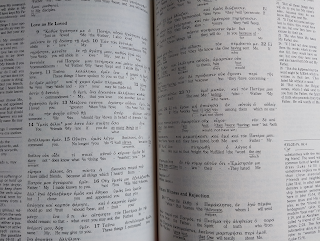
The gutters
The deep gutters
 

In themselves none of these are deal breakers. For example, this is one of the cheapest way to get a Hodges-Farstad GNT at the moment since it's currently out of print. Used copies go for as much as US$220 (~AU$350) on Amazon down to about US$100 on Ebay (~AU$120 including import taxes, shipping etc). Other than this, the cheapest way is to buy a Logos or Accordance module for around $32 or have a personal copy privately printed.

What are the pros?

I'm no expert when it comes to paper used in books but it seems to be about 70 gsm or maybe thinner. Despite the relative thinness of the paper, there is bleed through of the text on the reverse of each page, but it's not distracting and is quite faint. The paper is similar to high quality mass market paperbacks, light, smooth, and a pale creamy white colour. The text is crisp and comfortable to read. None of the text is crowded, but is fairly well spaced. The text is small but even with my 50-something eyes, it's still clear to me with or without my glasses.

Apparatus and Study Notes

There's a rudimentary apparatus which, as mentioned above, gives variant readings in the NA26/UBS4 text (NU), Majority (M or Byzantine), and TR. This is handy as it gives a quick overview of differences in the three major families. Unfortunately it hasn't been updated to refer to the current NA28/UBS5 editions.
There's study notes that have fairly in-depth discussions of 342 select Greek words. There's a word-study section in the rear has an index for the word study words. This is arranged in four columns with the Greek word, a transliteration, a gloss of the word, and a scripture reference to where this word is found.

The interlinear contains the Greek text, a literal translation and occasional idiomatic translations. Some of the English text is marked by numbers to give a proper English word order. Greek is a highly inflected which means word order is less important than the form of words. English has little inflection (e.g. -ing and -ed suffixes) and a Subject-Verb-Object (SVO) word order which means the literal translation can seem weird to English speakers and is a reason why a perfectly literal translation would be a bad idea. Numbering the English words makes it simpler for those who don't understand Greek to see how the English should read.

Interlinear information

The blue underlined word shows an example of their idiomatic translation of Εἰ (literally 'if') to 'otherwise'. The red underline indicates an instance where they've given a word order for the literal translation.

The edition is a fairly hefty and substantial volume weighing in at about 1.32 kg (2.91 pounds). Its dimensions are 6 x 2.25 x 9 inches and 936 pages. My preference would have been perhaps a 7x10 inch or US Letter/A4 block which would make it a somewhat thinner but it's not unwieldy or difficult to use even holding it in your hands. I would much prefer having the original GNT without an interlinear, even with something like a NKJV column, but absent that option I think this is just fine.

My Recommendation

Do I recommend this Edition? With a few minor caveats, yes. I'm not a TR or Majority Text primacist (nor an Alexandrian Text supremacist for that matter), but I do love God's word and would love to own as many editions as were created if it were possible and this is a good addition to my library. I feel the pros outweigh the cons and I would recommend it. If you want it to learn Greek, I'd advise against it, but if you want a Majority Text GNT to refer to this is a good option. Others such as the Robinson Pierpont MT is still in print for good prices and I would recommend getting both and not either, but that's just me.

Just be advised, the cover will attract finger prints and it's not good for daily reading. Those aside, if you want a print copy of the Hodges-Farstad GNT and don't want to go to the effort of a privately printed copy or spending hundreds of dollars on a second-hand copy, this is definitely worth adding to your library.

Thursday, June 9, 2022

 The Purpose Of This Site/Blog

For the past eight months or so I have been working on the creation of a new apparatus that compares as many Editions of the Greek texts commonly known as the New Testament as I can find. At the time of this post I am working my way through the Gospel of John and am nearing the end of chapter 6. I have completed a first pass of Matthew, Mark, Luke, James, 1 and 2 Peter, and 1, 2, and 3, John.

The Basis Text

The basis of this project is the final edition of Samuel Prideaux Tregelles' Edition of the Greek New Testament published in 1870 which consists of the combined volume of Matthew to Acts, the Epistles, and Romans to Philemon and Volume 6 containing 2 Thess 3:4 to the end of Revelation. This text  was chosen because it is a well respected edition and has escaped much of the controversy attached to such editions as that of Westcott and Hort and Nestle-Aland (apart from being an Alexandrian text).

Comparison Texts

To create the apparatus I have been researching and gathering numerous editions ranging from Stephanus' 1550 Edition to the 2017 Tyndale House Greek New Testament. To start with I am working with the following editions (in brackets are the codes I am currently using to denote them in my apparatus):

Textus Receptus (TR)

  • 1550 Stephanus (StA = Accordance Edition)
  • 1550 Stephanus (StL = Logos Edition)
  • 1598 Beza (Bez)
  • 1624 Elzevir (Elz)
  • 1898 Scrivener (Scr)

Byzantine/Majority Text (Byz)

  • 1985 The Greek New Testament According to the Majority Text 2E (HF)
  • 2014 The Greek New Testament According to Family 35 (F35)
  • 2018 Byzantine/Majority Textform GNT (RP)

Alexandrian (Alx)

  • 1880 Westcott & Hort's The Greek New Testament (WH)
  • 1869-1894 Tischendorf's Novum Testamentum Graece Editio Octavio Maior (Tisc)
  • 1904 Eberhard Nestle's Novum Testamentum Graece with 1912 corrections (N04)
  • 2009 Tregelles New Testament transcript v1 and 2 (TNT1 and TNT2)
  • 2010 SBL Greek New Testament (SBL)
  • 2012 Nestle Aland Novum Testamentum Graece 28th Edition (NA28)
  • 2017 The Greek New Testament produced at Tyndale House (THGNT)

The eagle eyed will note that I have two entries for Stephanus' Edition. While there is only one actual Stephanus edition published in 1550 the modules included in the Bible study apps Accordance and Logos have minor differences, usually the moveable nu and sigma. While these are minor and do not affect translation at all, they are frequent enough to warrant dividing them up almost as separate Editions along with similar variants in other editions.

Future Plans

Eventually I hope to add numerous other Greek NT Editions including those of Erasmus, Griesbach, Scholz (TR), the 1904 Patriarchal Greek NT (Byz), Von Soden and Open GNT (Alx) and a new family, the 'Caesarian' text-type proposed by Von Soden, Kirsopp Lake and others which includes Family 1 of the Gospels and Family13. These will be added in the second pass through of the text.

Other Purposes For the Blog

 As I progress through this project I am collecting resources and useful links that relate to the work. These will be added to 'Links' and 'Downloads' pages where I can do so (e.g. public domain or my own works).

As time goes on I hope to add posts on topics such as the modern Greek editions, ancient Greek NT manuscripts, Hebrew texts, ancient translations (e.g. Septuagint, Latin, Coptic etc) and perhaps some biographies of those who worked on Editions.

I will NOT be posting on any topics that do not relate directly to the Greek NT, its transmission, ancient manuscripts, early translations, modern Editions, textual criticism or a very narrow range of related topics.

What I do hope and pray is that learning more about God's inspired word (2 Tim 3:16, 17) in the original languages builds confidence in God and his word and blesses those who see my humble work.

The Journals are All But Complete

Today I finished and uploaded the last four books to the journals - 1, 3, & 4 Maccabees, and Ecclesiasticus or Wisdom of Sirach. There i...